

Digital Finance at WMF 2026: AI, Payments, MiCA, and the Digital Euro Redefine the Future of European FinTech
Digital finance has become an essential pillar of the global economy, seamlessly integrated into platforms, marketplaces, and online services. Instant payments, Artificial Intelligence, blockchain, tokenization, and insurtech are reshaping how value, trust, and financial intermediation are managed within the European economic ecosystem.
In this landscape, the ultimate challenge has shifted from mere technological innovation to building growth models that strictly comply with new European regulatory frameworks. Adhering to the EU AI Act for fintech-applied AI systems and the now fully operational MiCA (Markets in Crypto-Assets) regulation represents a core operational requirement for financial institutions, startups, and digital platforms alike.
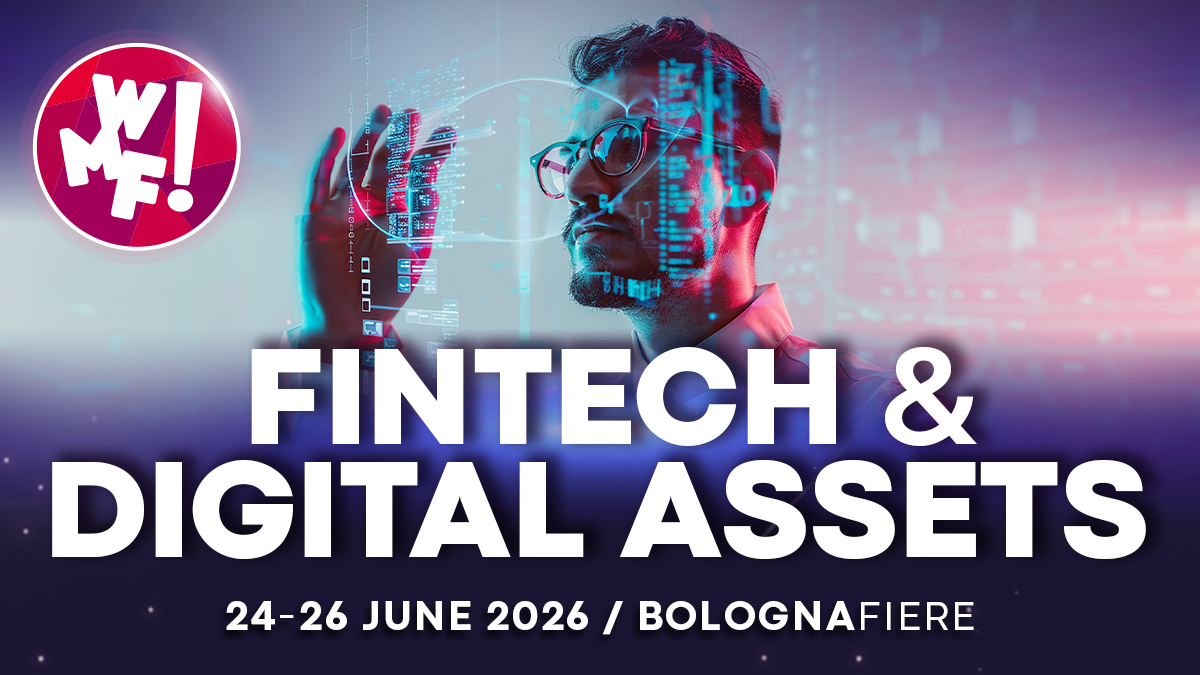
Against this backdrop, WMF – We Make Future (June 24–26 at BolognaFiere) stands as a premier observatory for the evolution of fintech and digital assets. This year, the festival’s FinTech & Digital Assets stage will serve as a dedicated forum to analyze how technology, regulation, and markets are converging toward a new European digital financial infrastructure.
From Vertical FinTech to Embedded Finance
The fintech sector has undergone a profound paradigm shift. The pioneering era dominated by vertical startups and standalone services has given way to a highly integrated model. Today, finance is becoming “embedded”—invisible to the end user but natively woven into digital workflows.
Payment services are directly embedded into e-commerce sites and marketplaces, credit facilities operate inside digital platforms, while insurance, investments, and risk management have become native features of online ecosystems. Competitive advantage is no longer determined by the financial product itself, but by the ability to build robust tech infrastructures, manage complex data, and automate processes.
This convergence between technology and financial intermediation forms the core theme running through the entire WMF fintech program.
As Cosmano Lombardo, Founder and CEO of Search On Media Group and creator of WMF, emphasizes:
“WMF serves as a privileged observatory on the transformation of digital finance, where payments, blockchain, artificial intelligence, and new regulatory models are converging into an increasingly integrated, programmable, and invisible economic infrastructure.“
Concurrently, European regulatory consolidation is redefining digital trust. Operational resilience is no longer a secondary afterthought but a strategic asset for banks, fintech companies, and technology providers. In this context, the DORA (Digital Operational Resilience Act)—fully enforced across the EU—plays a pivotal role by introducing strict standards for cybersecurity, business continuity, ICT risk management, and the protection of critical financial infrastructures.
The June 23 European Turning Point: Digital Euro, PSD3, and PSR
The 2026 edition of WMF arrives at a highly critical moment for the regulatory evolution of the sector. On June 23, on the very eve of the festival’s opening, the European Commission is expected to formally meet to approve the foundational pillars of the new European digital payments framework: the Digital Euro, PSD3, and PSR. These three files are destined to directly impact the entire European fintech ecosystem for years to come.
1. The Digital Euro: The ECB Accelerates Its Central Bank Digital Currency (CBDC)
The Digital Euro will not be a cryptocurrency, but a digital form of cash issued directly by the European Central Bank. The goal is to complement physical cash with a public, interoperable digital instrument usable across the entire Eurozone.
Key amendments passed by the European Parliament strengthened framework provisions regarding privacy, data security, and European technological sovereignty against non-EU payment rails. For a market dominated by international private payment giants, the ECB aims to create a public infrastructure that allows direct payments between the central bank and merchants, lowering intermediation costs and bolstering European autonomy.
2. PSD3 and PSR: Shifting the Rules of Digital Payments
Concurrently, the EU “Payments Package”—politically approved by the EU Council and the European Parliament—is moving forward. The main updates center on PSD3 and the PSR (Payment Services Regulation), which will progressively replace the current PSD2 framework.
- The PSR will introduce a single, directly applicable regulation across all Member States. Key objectives include strengthening Strong Customer Authentication (SCA), implementing advanced anti-fraud measures (such as IBAN-beneficiary verification), protecting users against spoofing, and ensuring fee transparency for instant credit transfers.
- PSD3 will update the licensing and supervisory framework for payment institutions, rebalancing the competitive playing field between traditional banks and fintech firms.
On an industrial level, this new European framework aims to accelerate open banking by promoting financial data-sharing and lowering barriers for third-party providers. Following its publication in the Official Journal, Member States will have roughly 18 months to transpose PSD3, with full enforcement expected across the market.
Inside the WMF FinTech & Digital Assets Stage
The WMF FinTech & Digital Assets stage provides a comprehensive cross-examination of the European financial system’s evolution, linking AI, payment networks, blockchain infrastructures, digital assets, regulations, and next-gen insurtech.
The program tracks three major market vectors:
- The increasing automation of financial processes.
- The deep integration of financial services into non-banking digital ecosystems.
- The development of new value models driven by tokenization and decentralized architectures.
The acceleration of AI in fintech extends far beyond automation and service personalization. In modern finance, algorithmic compliance is critical: credit scoring engines, fraud prevention systems, digital onboarding, and risk assessment models must align with the transparency and risk levels mandated by the EU AI Act.
Day 1: Digital Payments, AI, and Insurtech
The opening day of WMF will focus heavily on digital payments and fintech infrastructure integration:
- Luigi Traldi (Head of Southern Europe at Klarna) will deliver a highly anticipated keynote on the evolution of European payments and new platform business models.
- Gabriele Del Mese (Founder of Moneyviz) will break down the democratization of investments and retail market access.
- Roberto Garavaglia (Payment Systems & Blockchain Advisor) will analyze technical infrastructures and payment systems.
- Ionut Gaucan (ctrl/shift) will focus on digital model transformations.
- Simone Ranucci Brandimarte (President of the Italian Insurtech Association and Co-founder of Yolo Group) will explore data-driven insurance models.
- Fabrizio Romano Genovese (Founder of onetimelabs) will detail the new dynamics of digital innovation applied to financial services.
Day 2: Markets, Regulation, and Digital Assets
The second day shifts the focus to the intersection of capital markets, regulatory compliance, and institutional frameworks:
- Luca Carabetta (Trade Republic) will analyze structural changes in digital financial intermediation and investment access.
- Stefano Capaccioli (Founding Partner of Conlex and Tax Committee member at Moneyviz) will tackle the complex tax and regulatory hurdles facing digital assets in the European crypto market.
The digital asset debate takes place within a profoundly transformed European regulatory landscape. With MiCA in full effect, the European crypto market possesses a harmonized framework for digital assets, stablecoins, and Crypto-Asset Service Providers (CASPs). The industry’s maturity now relies on balancing innovation, transparency, investor protection, and institutional adoption—accelerating the integration between traditional finance (TradFi) and Web3 infrastructures.
Institutional perspectives will feature contributions from parliamentary representatives like Marcello Coppo (Italian Republic & Parliamentary Intergroup on “Digital Assets”) and public policy analysts like William Nonnis (Analyst – PNRR Presidency of the Council of Ministers), focusing on the National Recovery and Resilience Plan (PNRR). Luisa Fischietti (Head of Italy ETF at Borsa Italiana – Euronext Group) will close the segment with an in-depth look at regulated markets and ETFs.
Day 2 will also highlight digital identity, smart wallets, and Web3 infrastructure:
- Vincenzo Rana (Head of Innovation at the Milan Polytechnic Web3 Hub) will assess the impact of digital identity on payments and the potential of Zero-Knowledge Proofs (ZKPs) in managing sensitive public data.
Deep Tech: Space Economy, AI, and Insurtech Models
The rapid evolution of the Space Economy is beginning to exert a direct impact on both fintech and insurtech. By combining satellite Earth observation data with advanced AI models, insurance carriers can now calculate climate risks, extreme weather events, and territorial vulnerabilities in real time. Furthermore, satellite tracking has become a strategic tool for ESG finance and Green Bonds, enabling enterprises to objectively verify environmental parameters and supply chain sustainability to access green financing.
Day 3: Bitcoin, Web3, and AI-Driven Investing
The final day turns its attention to digital asset evolution and crypto infrastructure resilience:
- Luca Boiardi (CEO of The Crypto Gateway) and Marco Costanza (Bitcoin & Conscious Finance Creator) will offer complementary perspectives on the development of the Bitcoin market and the integration between TradFi and crypto culture.
Key topics will include crypto market maturation, tokenization use cases, decentralized finance (DeFi), and conscious finance. - Stefano Bargiacchi (AI Investor & Educator) will dissect the intersection of AI and financial investing, while Tommaso Astazi (Policy Director at Blockchain for Europe) will provide a breakdown of EU Web3 policies.
- Closing the innovative payments track, Roberto Garavaglia (Innovative Payments & Blockchain Strategic Advisor) and Marco Crotta (Conio.com) will map out the rise of agentic payments and automated, intelligent transaction systems.
FinTech District, Open Innovation, and Ecosystem Collaboration
Beyond the educational keynotes, WMF reinforces its role as an open innovation ecosystem for digital finance. The exhibition floor and specialized tracks covering Blockchain, Bitcoin engineering, and Web3 are built on an active dialogue with tech hubs and digital communities. Partnerships with entities like the Napoli Tech Hub, Ctrl/Shift, and the wider Italian Web3 ecosystem turn WMF into an open, collaborative marketplace connecting startups, venture capital, institutions, and fintech operators.
WMF as the Horizon for European Finance
The WMF fintech program delivers a definitive snapshot of where the European financial sector is heading: a market that is increasingly integrated, automated, and strictly regulated. While AI drives operational automation, cost reduction, and personalization, blockchain architectures, tokenization, the Digital Euro, and open banking are completely rewriting the concept of monetary infrastructure.
Simultaneously, the regulatory consolidation brought by MiCA, DORA, PSD3, PSR, and the AI Act transforms legal compliance into a primary competitive driver for banks and digital platforms. Balancing technological innovation, operational resilience, and institutional compliance, WMF confirms its status as an unmissable international hub for understanding the future of payments, markets, and digital assets.
Don’t miss the chance to experience the future of digital finance firsthand.
Secure your spot at Europe’s leading innovation festival. Tickets are officially available on the Official WMF Ticket Page. Remember the golden rule: the earlier you buy, the less you pay! Prices will scale up as the event approaches, so book your pass today to secure the best available rate.
Disclaimer
Disclaimer. This is a Corporate Press Release. Readers should do their own due diligence before taking any actions related to the promoted company or any of its affiliates or services. Cryptopolitan.com is not responsible, directly or indirectly, for any damage or loss caused or alleged to be caused by or in connection with the use of or reliance on any content, goods or services mentioned in the press release.